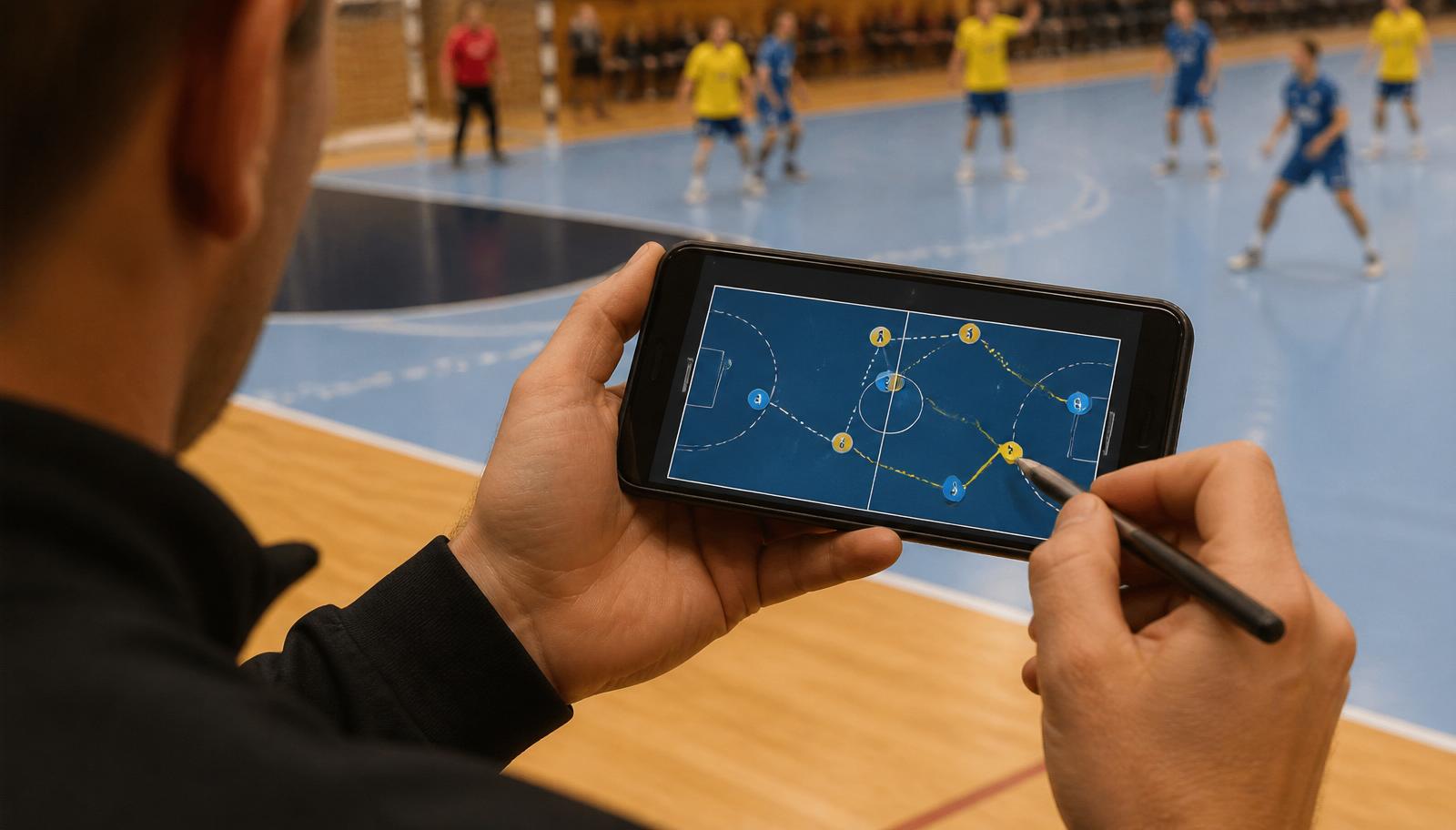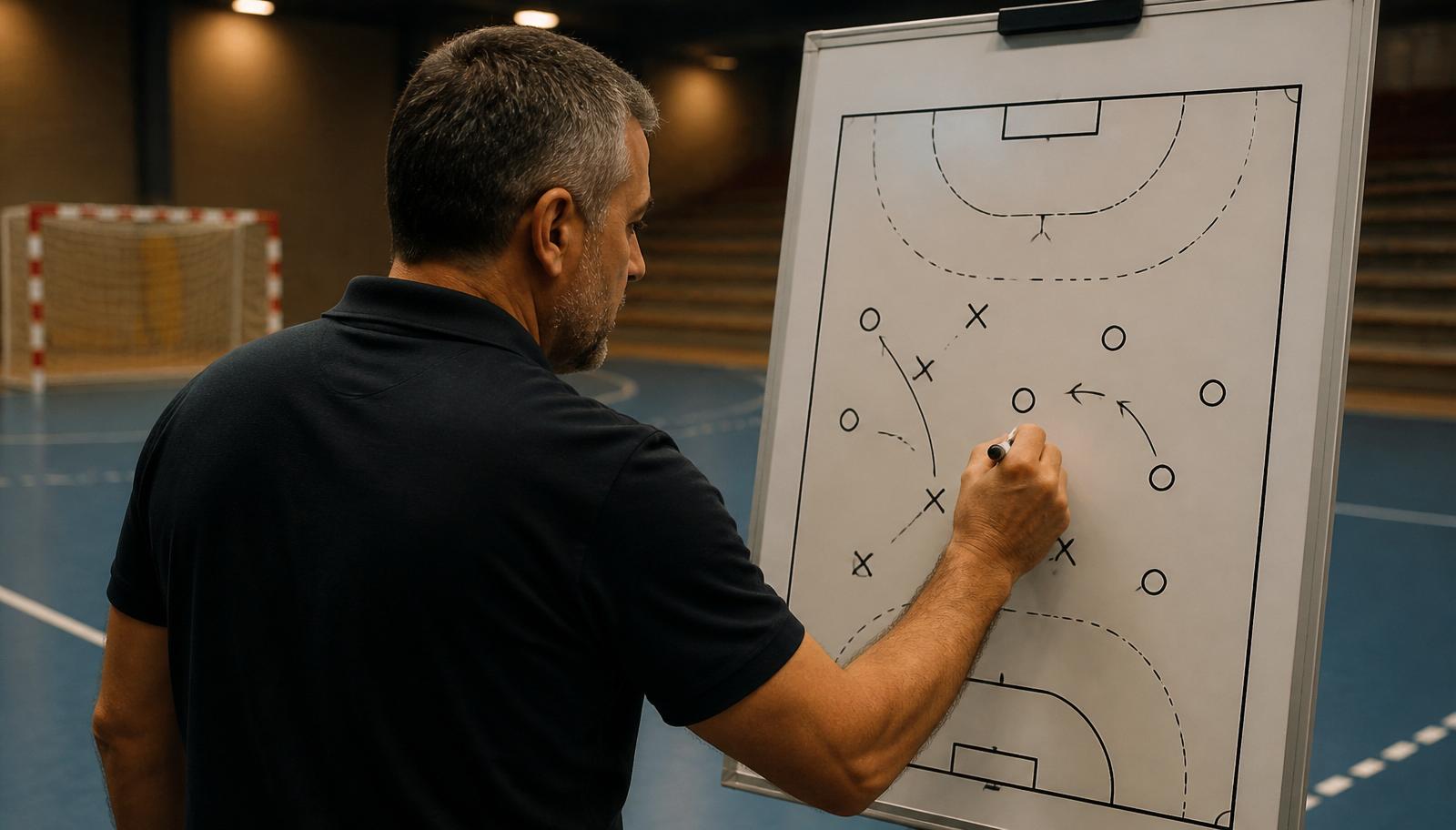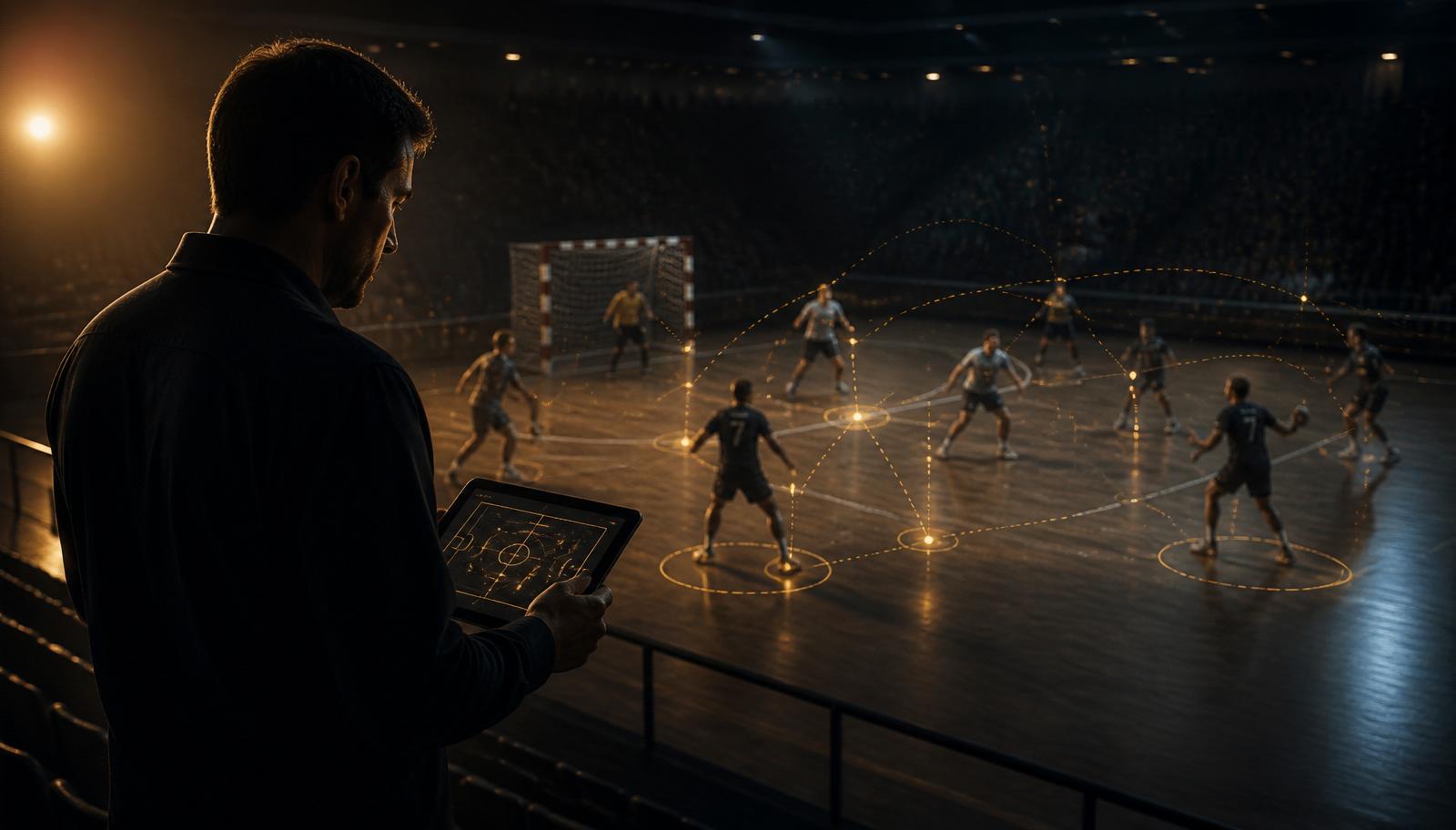
For most of us, AI in handball still sounds like something from a federation conference, not from a Tuesday night training. The week runs on a notebook, a video folder, two group chats, and whatever you can hold in your head.
So it is easy to assume the technology has not really shown up yet.
It has. It just did not show up at the coach's desk first.
- AI is already in handball — but mostly in cameras, sensors and broadcast, not in your weekly planning.
- The bottleneck is translation, not data. Coaches don't need more numbers; they need help turning context into the next session.
- Handball is earlier on the curve than football. That is an opening, not a gap.
- The next wave is a coach-facing assistant that drafts the week and leaves the judgement to you.
The first wave landed in capture, not coaching
Look at where AI is actually working in handball today and a pattern appears quickly. It lives in the parts of the game that are easiest to record and measure.
Automated cameras now film whole competitions without a crew. Pixellot reports that the Korea Handball Federation streamed all 149 matches of a competition involving 85 teams — from school level to professional — with automated production. The Icelandic Handball Association runs an arena network with Spiideo described as roughly 20 venues and more than 50 AI-operated cameras.
Tracking has gone league-wide. The Handball-Bundesliga has used KINEXON sensor tracking since the 2019/20 season, capturing player and ball data in real time. Both the league and the EHF have extended those partnerships into the late 2020s.
Video replay is part of elite officiating now, supplied across EHF competitions. Match analysis and prediction are moving too — though more carefully than the headlines suggest. Handball.ai has been validated as a reliable observation tool, but a human still enters several of its key variables by hand. Most of the prediction work still lives in academic papers rather than in clubs.
So the honest summary is this:
AI adoption in handball is real, but it is concentrated. It sits in capture, measurement and broadcast — mostly at federation and elite-club level. Very little of it has reached the coach who plans the week.
Why it landed there and not with you
None of this is an accident. Those are the problems AI handles cleanly right now:
- Record the match.
- Track the movement.
- Cut the clips.
- Estimate a probability.
Each one has a clear output you can check.
Coaching is harder, because your next decision rarely depends on a single signal.
A transition-defence problem might be tactical, physical, or just about who turned up. A heavy training load can be exactly right in week two of pre-season and exactly wrong three days before a match. A good drill can still be the wrong drill for the eleven players you actually have on Thursday.
A camera never has to weigh any of that. You do.
It is not a data problem. It is a translation problem.
Here is the part that gets missed.
The bottleneck in everyday coaching is not a shortage of information. Most coaches already have video, attendance, match notes, a season plan and a drill folder. The hard part is turning all of it into the right next session, week after week, under time pressure.
More data does not fix that on its own. A dashboard with ten more numbers can make the decision slower, not faster.
What is missing is the layer that connects context to a decision a coach can use. Today, that layer is you — the one holding the calendar, the squad, the method and last week's match cycle in your head at the same time.
That works until the night you are tired. Or the season you are running two teams. Or the day an experienced coach leaves and takes half the club's method with them.
The biggest risk in a club is not losing a file. It is losing the way of working when the person who carried it walks out the door.
The bottleneck is not more data. It is a translation layer that turns context into the next session, without losing the method.
Handball is earlier on the curve than football. That is the opening.
Set handball next to football, basketball or American football and it sits earlier on the adoption curve. The data is thinner, the tools are fewer, and the coach-facing layer is barely built.
It is tempting to read that as being behind. It is more useful to read it as room.
The expensive infrastructure wave — the cameras and the sensors — was never going to reach a normal youth club anyway. The wave that can reach a youth club is the one nobody has finished building yet: structured help inside the planning itself, for the coach working mostly alone.
What the next wave actually looks like
The next step is not an AI that coaches for you. It is an assistant that works with you, inside the routine you already run.
It drafts the week. Finds a drill that fits the age group and the day. Flags a calendar clash. And leaves the judgement where it belongs.
At SquadX that assistant is Coach Lucas, and the line we hold is simple. The method is Gintaras Savukynas's — EHF Master Coach, head coach of Bergsøy IL in Norway's Eliteserien, former head coach of the Lithuania national team.
Lucas applies that method. You review it, change it, and decide. The assistant removes the busywork, not the coaching.
That is the difference between a tool that produces a plausible-looking session and a system that helps you run a season.
If you want to see it on your own bench, you can start a free SquadX trial — free until 1 September, then €19.90/mo.
Where this leaves the coach
AI has entered handball. The first era helped the sport capture and analyse the game. The next era will help coaches act on what the game already shows — without handing over the decisions that should stay human.
The tools will keep coming, and access to them will become normal. The advantage will go to the coaches and clubs that learn early how to use them without losing the method, or the judgement, that makes coaching work in the first place.
If you want the full picture — what is genuinely operational, what is still experimental, and what is mostly hype — we pulled it together in one place: the AI Has Entered Handball report.
Sources referenced: Pixellot (Korea Handball Federation case), Spiideo (Icelandic Handball Association case), DAIKIN Handball-Bundesliga and EHF (KINEXON tracking partnerships), Marquina et al. 2023 (Handball.ai validation). Full source list in the AI Has Entered Handball report.
Gintaras Savukynas is co-founder of SquadX and head coach of Bergsøy IL in Norway's Eliteserien. An EHF Master Coach with over 20 years on the bench, he has led the Lithuania national team, won three consecutive trebles with Riihimäen Cocks, and reached the EHF Champions League with both Cocks and HC Motor Zaporizhzhia. SquadX is built on his methodology.