A back court player throws in almost every drill of every session, week after week. Shoulder injuries in throwing athletes come mainly from overuse (Andersson et al., 2017). They build up from that repetition rather than from one bad fall, and they grow slowly. Many players keep playing with them, and many coaches find out late.
How common shoulder problems are
Researchers describe shoulder problems as highly prevalent among elite handball players (Andersson et al., 2017). They start young. In a Danish study of elite youth players aged 14 to 18, one in five already had handball-related shoulder pain when the season began (Aarhus University, 2017).
Why they stay hidden
Overuse problems rarely stop a player in one moment. The shoulder aches after training, feels fine the next day, and aches a little more the week after. Players keep throwing because they want to play, and few of them mention it in front of the team.
What raises the risk
Sudden jumps in load
The same Danish study followed 679 youth players for 31 weeks. Players whose weekly handball hours rose by more than 60 percent compared with their average over the previous four weeks had a higher shoulder injury rate than players whose load stayed within 20 percent (Møller et al., 2017). The result sat at the edge of statistical significance, so read 60 percent as a warning level rather than a precise limit.
Weak or poorly controlled shoulders
Reduced shoulder rotation, weakness in external rotation and poor control of the shoulder blade have been identified as risk factors in elite handball (Andersson et al., 2017). In the Danish youth study, the authors single out players with weak external rotation strength or poor shoulder blade control as especially affected by sudden load increases. The two risks work together, which is why the advice below covers both.
Prevention in the warm-up works
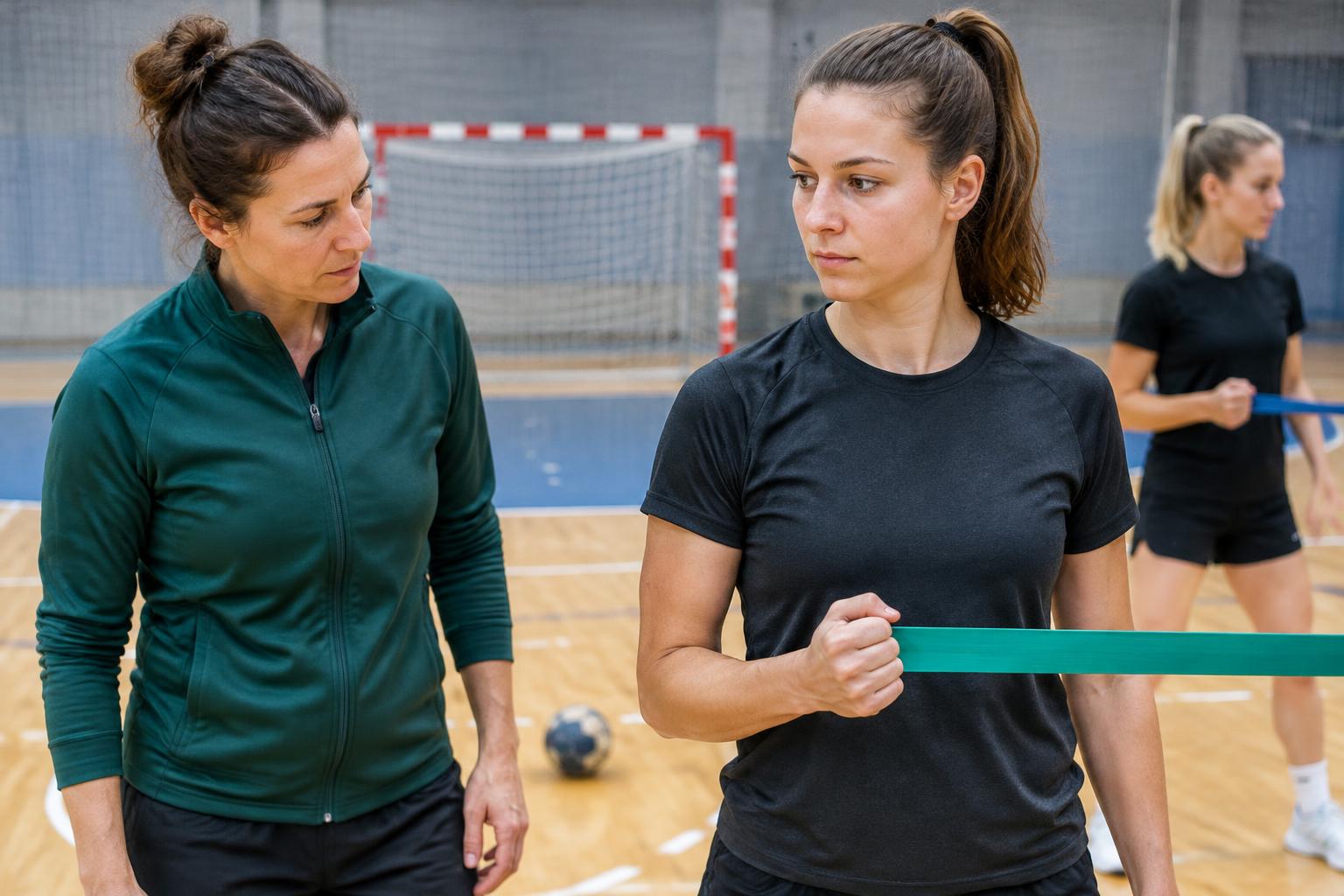
A Norwegian trial put this to the test. 45 elite teams, 660 players in total, were split into two groups for a full seven-month season. In one group, coaches and captains ran a shoulder programme three times a week as part of the warm-up. The other warmed up as usual. The programme group had a 28 percent lower risk of shoulder problems, and the authors recommended it as part of the warm-up (Andersson et al., 2017).
The programme was developed at the Oslo Sports Trauma Research Center. It aims to improve internal rotation range, external rotation strength and the strength of the muscles around the shoulder blade, along with mobility of the upper back and the rest of the throwing chain. A later trial registration describes it as a 10-minute warm-up of five exercises (ISRCTN13272376). The trial paper in the sources describes the programme, and a physiotherapist can take the team through the exercises the first time.
Put a shoulder programme into the warm-up of every session that includes throwing, and keep each player's weekly handball hours from jumping more than 60 percent above their recent average.
Three things a coach can change this season
1. Make the shoulder part of every warm-up
The trial built the programme into the normal warm-up instead of adding a separate session. That is the easiest change on this list and the one with the best evidence.
2. Plan the spikes you can see coming
Most load jumps in handball are on the calendar: the first weeks of pre-season, the return after Christmas, tournament weekends, and youth players who also play in an older age group. Build up over two or three weeks instead of starting at full volume. A player returning from injury needs the same gradual build.
3. Ask about the shoulder every week, privately
One short question after training or a match is enough: is anything hurting, and where? Players answer more honestly in private than in the locker room, and the answers become useful when you can see them week after week. A shoulder that comes up three weeks in a row is a different situation from one bad day.
When to involve a physiotherapist
Pain that does not settle after a few days of lighter training, pain at rest or at night, or a clear loss of throwing power are reasons to have the shoulder assessed by a physiotherapist or doctor. This article is general information for coaches, not medical advice.
Where SquadX fits
Before each match, players can flag soreness or pain in their SquadX player app check-in, and Coach Lucas lists who to watch in the brief, so you see it before the warm-up. Every answer stays on record, match after match, which makes a shoulder that keeps coming back easier to spot.
Quick answers